

Written by Ilana Laurence, MHC, MA, MEd
“Where do you feel that in your body?” is one of those questions that often stumps clients in therapy. “I think maybe in my head?” isn’t usually the answer therapists are looking for.
From our perspective, it’s usually pretty obvious when our clients are stuck in an intellectualizing loop. But as clinicians, it can feel just as difficult to step out of our heads and into our own sensory experience. We spend hours each week listening, contemplating, and reflecting on the words and ideas that clients bring to sessions.
In a world that rewards rational thinking and problem-solving, it makes sense that many of us approach unpleasant feelings the same way. Thinking can help us understand our emotions, but it can also become a remarkably effective way of avoiding actually feeling them.
For some, the antidote to intellectualizing can be engaging in something tangible and creative. For me, the answer has been clay.
I spend hours each week with my hands caked in this messy, malleable material. Without asking me to think, clay engages my senses, demands my attention, and offers the satisfaction of transforming something formless into something tangible. But I’ve also come to appreciate that its therapeutic value lies as much in the frustrations it brings as in the pleasures it provides.
Clay doesn’t always cooperate. Neither do many other artistic or creative endeavors. A planted bulb might not bloom, a charcoal drawing could smudge, or a bowl might warp in the kiln.
Our instinct might be to analyze what went wrong or figure out how to fix it, but working with physical materials has a way of making us feel frustration, disappointment, or impatience before we can think our way around it. It asks us to notice what is actually within our control and to surrender what isn’t. Some things are destroyed and others are repaired, and at times we have to accept that what we’ve made isn’t at all what we intended.
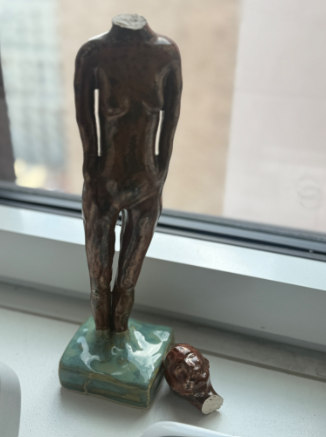
Sometimes, this lesson arrives in an even more literal form. The little statue pictured above lost her head when an overzealous window-opener knocked it off. “Stay in your body,” she whispers. “Let your thoughts go!”
In this way, working with clay has become an unexpected exercise in tolerating discomfort. And isn’t that so much of what we do in therapy? We help our clients move beyond understanding their feelings intellectually and toward actually experiencing them, without immediately trying to explain them away or make them disappear.
We still may not be particularly good at answering where we feel something in our bodies. But for some of us, spending time creating things outside of ourselves has taught us that often the best way to understand what we’re feeling is to stop trying so hard to figure it out.