

In the years since the COVID-19 pandemic, survey after survey has identified sky-high rates of burnout among American workers. A 2022 survey conducted by the American Psychological Association found 3 in 5 respondents identified feelings of burnout, including lack of interest, cognitive weariness, emotional exhaustion, and physical fatigue. According to the Harvard Business Review, 55 percent of employees feel unable to establish work-life balance and maintain connections with family and friends. So how do we find that balance? Can we change our relationship to work and career so it’s something that enhances our quality of life?
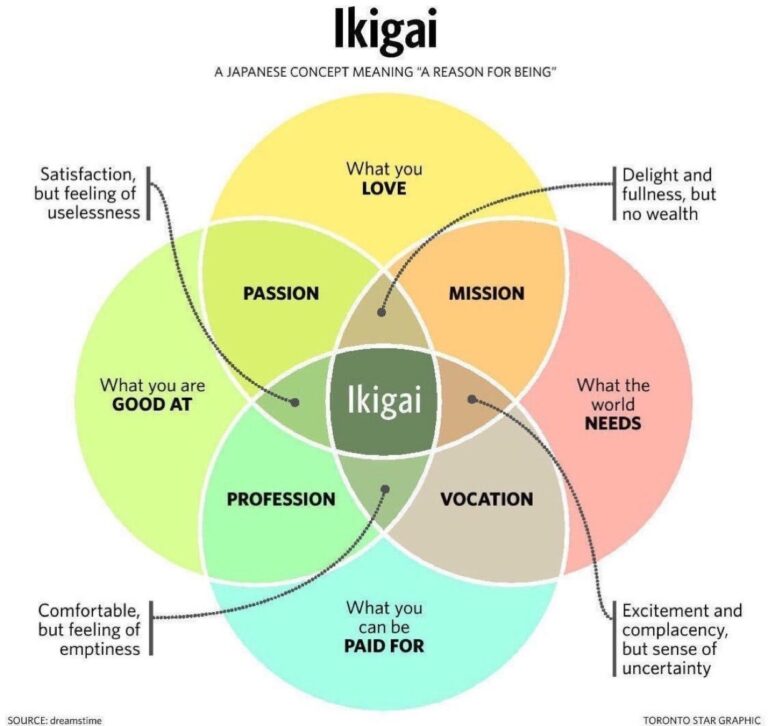
Enter “Ikigai”– a concept derived from two Japanese words– “iki” (life) and “gai” (worth) representing the the intersection of four key components: (1) what you love; (2) what you are good at; (3) what the world needs; and (4) what you can be paid for. You can imagine these four elements as overlapping circles on a Venn diagram. At the center lies the sweet spot where all these aspects converge forming a harmonious balance between personal fulfillment, societal contribution, and financial stability.
But how do we use this concept? According to sports and performance psychologist, Dr. Jonathan Fader, an experienced therapist or career coach would help you to use ikigai as a structured way to consider unstructured questions like, What do I like? and What are my values? Ikigai further helps to identify any mental filters through which we might be thinking about these questions.
For example, when choosing a career path, most of us tend to prioritize earning potential– What can I get paid for?– and hope to find something we’re qualified to do–What am I good at? Although we might think that a steady paycheck and job security will bring us happiness and fulfillment, research suggests otherwise. A decades-long Harvard University study on adult human development found that the number one predictor of happiness and life satisfaction was the quality of close relationships. As researcher Dr. Robert Waldingerput it, close relationships “ are automatic mood boosters, while isolation is a mood buster.” Another longitudinal study out of the United Kingdom found a strong correlation between happiness and having a sense of purpose, which was found to be further associated with strong personal relationships.
So what happens if we remove the mental filter of What can I get paid for? and start asking, What do I love? And What does the world need? According to Dr. Fader, a performance coach or therapist helps you to “speak about those things, lay them all out on the table, and build the confidence and motivation to go after them.” This is not to say that money and skill set aren’t important– remember, ikigai is about finding balance among the four quadrants– but it’s worth considering how the emphasis on money or prestige can cloud our view of what is more important. With a change in perspective, or a different point of view, you just might yourself with a sense of purpose, surrounded by like-minded individuals with whom to build relationships.
If you’re feeling burnt out, looking to make a career change or change your relationship to work, visit our page on career and performance coaching.